

Aerial releases require venue and flight approval. Category requirements are in Section 4.
CS §11. Purpose and scope
HERO Challenge is a multidisciplinary educational event combining aerial and ground robots with practical work in mechanics, electronics, programming and communication. HERO Explorer and HERO Pro indicate difficulty, not age. Teams may choose their level and enter other challenges.
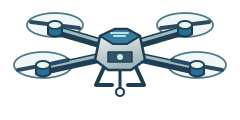
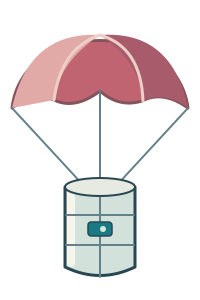
Teams build a compact CanSat integrating a structure, sensors, electronics and software. An organiser-operated drone releases it for passive parachute descent; powered flight and steering during descent are prohibited.
CanSat Descent transmits sensor data to a laptop and ends at landing. CanSat Comeback prepares for ground travel after landing and drives to a target autonomously. Teams choose either mission or enter both separately; shared safety rules apply.
CanSat Descent
- 1Release
From the carrier
- 2Descent & data
Transmit sensor readings
- 3Touchdown
Mission ends
CanSat Comeback
- 1Release
From the carrier
- 2Descent
Under parachute
- 3Touchdown
Prepare for ground travel
- 4Autonomous return
Navigate to the target
Figure 1. Example Descent and Comeback missions.
Descent teams can skip Sections 4.2-4.3, 10.4-10.5 and 13.2-13.5. Section 11’s ground-target rules are Comeback only. Shared safety and inspection rules apply to both.
CS §22. Authority and rule precedence
- The HMDS Organizing Committee organizes the event.
- The Technical Committee interprets rules, approves submissions and resolves rule protests.
- The Flight Operations Lead controls all drone and release activity.
- The Safety Officer may stop or cancel any activity presenting unacceptable risk.
- The Head Referee controls scored runs and factual decisions made during a run.
- Published edition notices, approved Q&A and safety instructions form part of these rules.
- The English rules are official. Translations are for reference unless stated otherwise.
CS §33. Eligibility and team composition
- The technical mission limit is 1-7 students; mixed high-school/university and solo entries are allowed. HERO’s Space roster allows up to three competitors plus a competing captain, so a Space-only CanSat lineup has 1-4 competitors. The smaller limit governs.
- Each team shall designate one Team Captain as the official contact.
- University advisors are optional. Each team with high-school members needs a registered adult supervisor on site.
- Advisors and supervisors may guide students but may not work on the CanSat during a scored run.
- Commercial components are allowed when listed in the Technical Design Report (TDR), the short design report described in Section 15.
- Choose CanSat Descent or CanSat Comeback, or enter both separately. Students may join one team per division and choose different levels in other HERO challenges. A CanSat may not be shared between teams.
CS §44. Mission requirements and dimensions
CS §4.14.1 CanSat Descent
Build a closed can-sized body with sensors, a battery, electronics and a radio transmitter, plus a parachute. Use a receiver connected to your laptop to save the measurements. No wheels, opening shell or ground navigation are required.
CanSat Descent · maximums
- Body diameter
- Ø 66 mm
- Body height
- 115 mm
- Ready to release · includes parachute + attachments
- 350 g
Figure 2. CanSat Descent body dimensions.
The 66 x 115 mm body follows the ESA CanSat format. The parachute is outside this body envelope. External antennas and attachments need carrier-fit approval. The 350 g total limit is an HMDS adaptation; there is no minimum mass.
Measure at least one physical quantity chosen by the team and transmit at least one reading per second during descent. Include time and units in the data. Pressure and temperature are useful examples, not mandatory sensors. Teams choose their laptop, sensors and radio.
The ground station (laptop and receiver) saves data but must not steer the CanSat. After landing, the CanSat must remain closed and safe to recover. Submit the received data, a labelled graph and a short explanation after recovery.
Figure 3. CanSat descent, viewed from below. ©ESA, 2020 [10].
CS §4.24.2 CanSat Comeback stored size and mass
The following stored-size and mass limits apply to CanSat Comeback. All packed parts, including the parachute, must fit inside this envelope.
CanSat Comeback · maximums
- Stored diameter
- Ø 146 mm
- Stored height
- 300 mm
- Ready to release · includes parachute + all appendages
- 1,050 g
- Deployed width × depth × height
- 600 × 600 × 400 mm
The packed CanSat must fit inside the stored dimensions without being squeezed into the carrier, the organizer’s holder and release mechanism. Nothing may remain in the carrier after release.
Figure 4. CanSat Comeback stored dimensions.
CS §4.34.3 CanSat Comeback design freedom
Build a vehicle with a parachute, battery, electronics, landing detection and a system for autonomous ground travel. Wheels, tracks, legs or a rolling shell are allowed. Teams choose the processor, sensors and navigation method. An opening shell or unfolding mechanism is optional.
Figure 5. ARLISS two-wheel rover. Saito and Akiyama [9].
CS §55. General technical requirements
Both categories must meet these requirements. Movement and deployment checks apply only where those mechanisms are fitted. Every CanSat must:
- have a clearly labelled team name and vehicle identifier;
- have an accessible main power switch;
- have a safe handling state that disables propulsion and deployment actuators, where fitted;
- mechanically retain batteries and all parts through release and landing, and during movement except for approved recovery components separated after landing under Section 6;
- contain no exposed sharp edge or accessible hazardous moving part;
- contain no pyrotechnics, combustion, hazardous chemicals, pressure vessels or harmful liquids;
- not scatter or abandon objects; approved parachute or shell separation under Section 6 is allowed, with recovery after the run;
- use colours that are easy to see against grass, soil and pavement;
- remain locatable after release using onboard GNSS, beacon, telemetry, or another approved method;
- fail safely following a software fault or loss of a safety-critical link. Loss of optional telemetry alone need not stop a safely autonomous rover. Declare and test link-loss behaviour during inspection;
- for Comeback, stop propulsion at mission end or upon the approved emergency-stop command;
- for Comeback, remain within the approved deployed envelope.
CS §66. Recovery and descent system
- A parachute or equivalent passive recovery system is mandatory.
- Uncontrolled free fall is prohibited. The recovery system must open promptly after release.
- The descent speed near the ground must not exceed 6 m/s. Show a safe landing at the ready-to-release mass; slower descent is allowed if drift remains within the approved area.
- Submit descent-test results with the TDR and repeat a test if requested.
- Powered flight and directional control during descent are prohibited.
- Landing must not expose batteries, detach parts on impact or create sharp debris. Approved recovery components may separate after landing under the rules below.
- The recovery system shall not entangle the organizer’s carrier or release drone.
- Comeback only: the parachute may be collapsed, reeled in or separated as needed for safe ground travel. It must stay recoverable and not blow away; pyrotechnics are prohibited. Descent needs no separation mechanism.
- Comeback only: if the design uses an opening protective shell, it may stay at the landing point after inspection approval. Collect the shell and parachute after the run.
CS §77. Energy storage and electrical safety
- Battery chemistry, cell count, nominal voltage, capacity, and maximum energy shall be declared.
- Commercially manufactured battery packs are strongly recommended. For beginner and high-school Descent teams, consider alkaline cells; 9 V must suit the electronics' voltage and current needs.
- Packs showing swelling, puncture, damaged wrapping, exposed conductors, or thermal damage are rejected.
- Batteries shall be mechanically retained; adhesive or hook-and-loop material alone is insufficient.
- Charge only in the designated area, on a non-combustible surface. Someone must stay with the batteries while they charge.
- Spare batteries shall be stored in a fire-resistant container.
- All exposed power terminals shall be insulated against short circuits.
- Battery replacement after final inspection requires re-inspection.
CS §88. Radio and navigation systems
- All transmitters shall comply with Japanese radio requirements and be declared in the TDR.
- The organization may assign channels or prohibit a device that creates interference.
- Two-way machine communication is permitted only when it operates autonomously without human intervention.
- After the Start Signal, human steering, teleoperation and human-generated mission commands are prohibited except emergency stop. Automatic data exchange is allowed; locked target data must not change.
- An emergency stop ends the run but does not constitute prohibited assistance.
- Sending sensor data to the team laptop is required for Descent. Comeback may transmit data but does not have to.
- For Comeback, load the target data before staging. Do not change it once the target data are locked.
- Comeback navigation may use satellite positioning (GNSS), compass and motion sensors, wheel-distance measurements, cameras or distance sensors, alone or combined.
Figure 6. Communication during the mission.
CS §99. Carrier and organizer release drone
- The release drone, pilot, payload carrier, and release command are provided or approved by the organization.
- Teams shall not operate, modify, or communicate with the release drone.
- The holder mechanism, interface drawing and packing instructions will be published at least four weeks before the first competition day. Use the body limits in Section 4 now; do not finalise the carrier attachment before checking the interface.
- The CanSat must enter and leave the carrier without jamming, snagging or leaving material behind.
- The CanSat shall remain electrically safe and mechanically secured until the official release.
The Start Signal is the official release or, in the ground alternative in Section 12.1, the referee’s start signal. For aerial release, sensors may run beforehand; propulsion and deployment must remain safe until touchdown.
- The planned release height is 20-30 m. Before aerial attempts, the Flight Operations Lead must validate the carrier and payload, release clearance, parachute deployment at the authorized height, and operating weather limits with the pilot. Publish these limits with the field notice in Section 11 and announce the authorized height before staging. This guide does not constitute flight permission.
- The pilot, Flight Lead, Safety Officer and Head Referee must all clear the range.
CS §1010. Mission sequence
CS §10.110.1 Pre-run
- The team reports to staging at the scheduled time.
- Inspectors verify the label, mass, size, battery, switch, carrier fit and radio declaration.
- Comeback teams lock their target data. Descent teams check the receiving link and align the laptop clock with the referee’s clock.
- The organization installs the CanSat in the carrier.
- Team members withdraw to the operator/spectator area.
Figure 7. Pre-run sequence.
CS §10.210.2 Aerial phase
- The remote pilot arms and launches the carrier drone.
- The drone moves to the approved release position and height.
- The Flight Operations Lead authorizes release.
- The CanSat is released and descends passively.
- Comeback only: do not start ground movement or unsafe deployment before the CanSat detects landing.
CS §10.310.3 CanSat Descent mission end
The scored flight ends at touchdown or when an official stops the attempt. Receive sensor data during descent; no movement is required after landing. Wait for permission to enter the field, then recover the CanSat and export the ground-station log.
CS §10.410.4 CanSat Comeback surface phase
After autonomous landing confirmation, the CanSat shall:
- prepare for safe movement on the ground;
- manage the recovery system;
- deploy any fitted mechanisms or orient itself as needed for safe movement;
- start moving autonomously on the ground;
- reach a point at least 5 m from its landing point under valid autonomous control;
- navigate toward the target;
- stop when it reaches its programmed completion condition or the Run Time Limit expires.
CS §10.510.5 CanSat Comeback mission end
For Comeback only, the mission ends when the first of the following occurs:
- the CanSat stops within 5 m of the target reference point (the Goal Zone) and declares mission completion automatically through an inspected indicator, telemetry message or timestamped onboard event. A human announcement does not count;
- the Run Time Limit of 10 minutes from official release expires;
- the CanSat leaves the Field of Play;
- an emergency stop is commanded;
- the Head Referee or Safety Officer ends the run.
CS §1111. Field and target
Both missions use the approved release and landing area. Only Comeback uses the ground target and distance rules below.
- The organizers will publish the terrain, field boundaries, exclusion zones, target coordinates and layout at least four weeks before the first competition day. Use the published layout when planning and testing navigation.
- A high-visibility cone or equivalent marker stands beside a flat ground mark identifying the target centre. Target coordinates and distance measurements refer to the ground mark, not the cone. The field layout shows both positions.
- Final distance is measured horizontally from the marked target centre to the nearest controllable part of the stopped CanSat. Touching that centre gives zero distance. Passing over the flat target mark is not a collision; hitting the adjacent marker is subject to Section 14.
- Detached string, parachute material and ejected objects do not count as the vehicle.
- Target-accuracy points require the vehicle to reach at least 5 m from its landing point. Circling in place does not qualify.
- No team beacons, markings or field equipment unless the published field notice permits them.
CS §1212. Attempts and reruns
- One scored attempt per category. Extra attempts must be announced for all teams before scoring starts in that category; the best score then counts.
- A rerun may be granted for organizer, field, carrier or drone faults not caused by the team.
- No rerun for CanSat faults, recovery failure, low battery, navigation error or lost equipment.
- If aerial release is unavailable, the Committee may activate the announced backup arrangement, use the alternative below, or cancel if no safe venue is available. Any aerial release requires venue and flight approval.
CS §12.112.1 Alternative without aerial release
The Head Referee declares this mode before scoring; all teams in the category use it. Never mix aerial and alternative scores. Inspection, radio, applicable emergency-stop and pre-flight evidence requirements still apply.
Descent: the closed CanSat transmits readings from a stable support to the laptop for 60 seconds. Apply Section 13.1, using the referee’s start signal and the 60-second end in place of release and touchdown; count 60 complete one-second intervals. Maximum 800, with no descent or landing points. Submit the log and analysis within 60 minutes after the test.
Comeback: officials place the packed CanSat and recovery system at the marked start. At the referee’s signal, its declared ground-start mode may deploy and move; no later assistance is allowed. Apply Sections 13.2-13.5 with that signal replacing landing detection and starting the ten-minute limit and time bonus. Maximum 850: no release/descent or landing-detection points. Require at least 5 m autonomous displacement from the start.
CS §1313. Scoring
CS §13.113.1 CanSat Descent evaluation
The highest score wins. Referees record release and touchdown times. The laptop must save received measurements, units and receipt timestamps, not only a live display.
| Task | Points |
|---|---|
| Controlled parachute descent, without uncontrolled free fall | 100 |
| Safe landing with body and battery retained | 100 |
| Sensor readings received during descent | 400 |
| Design and pre-flight test evidence | 200 |
| Submitted graph and interpretation | 200 |
| Base total | 1,000 |
Data score = 400 x covered intervals / complete intervals. Starting at release, count complete one-second intervals: 0 to less than 1 s, 1 to less than 2 s, and so on. An interval is covered if the laptop receives at least one valid reading with its quantity, units and timestamp. Use laptop receipt times. A reading on a boundary belongs to the next interval; ignore the final partial interval and readings at or after touchdown. For a flight under one second, one valid reading during flight earns 400; no reading earns zero. Round to one decimal place.
Example: a 3.7 s flight has three complete intervals. Readings in two of them earn 400 x 2/3 = 266.7 points. Extra readings in one interval do not increase its score.
Design evidence: 100 for the layout, mass, battery and radio description; 100 for safe drop-test evidence and a working data link. Each item earns full points or zero.
Analysis: 100 for a labelled graph with time and units; 100 for an explanation of the observed readings, including missing or unusual values. Submit the log and analysis within 60 minutes after recovery.
Descent ties: data score, then analysis, then design evidence; otherwise share the placing.
CS §13.213.2 CanSat Comeback scoring
This 1,000-point base table applies only to CanSat Comeback. Fixed task points are awarded in full when demonstrated, otherwise zero. Distance and time points use Sections 13.3-13.4. The highest score wins.
| Task | Points |
|---|---|
| Safe release and controlled descent | 100 |
| Autonomous landing detection | 50 |
| Valid deployment/ground-operating configuration | 100 |
| Recovery-system management | 50 |
| Autonomous surface movement begins | 100 |
| At least 5 m from the landing point under autonomous control | 100 |
| Target accuracy | 300 |
| Mission time bonus | 100 |
| Valid control-record submission | 100 |
| Base total | 1,000 |
Deployment points cover the intended ground-operating configuration even if nothing unfolds. Recovery points require the parachute and any shell to remain recoverable without obstructing travel. Rank by base points plus the filming bonus, less penalties. Comeback ties use shorter final distance, then control-record score, then shorter successful Mission Time; otherwise the placing is shared.
CS §13.313.3 CanSat Comeback target accuracy
| Final distance to target | Points |
|---|---|
| 1.00 m or less | 300 |
| More than 1.00 m to 2.00 m | 270 |
| More than 2.00 m to 5.00 m | 220 |
| More than 5.00 m to 10.00 m | 160 |
| More than 10.00 m to 20.00 m | 80 |
| More than 20.00 m | 0 |
Target-accuracy points require a displacement of at least 5 m from the landing point under autonomous control.
Figure 8. Target-distance measurement; not to scale.
CS §13.413.4 CanSat Comeback time bonus
The time bonus requires successful autonomous completion under Section 10.5: at least 5 m displacement, an autonomous stop within the 5 m Goal Zone and a declaration of mission completion. Emergency stops and runs terminated by officials earn no time bonus. Mission Time runs from the Start Signal to the successful stop:
Time Bonus = 100 × (Run Time Limit − Mission Time) / Run Time Limit
The result is rounded to one decimal place and cannot be negative.
CS §13.513.5 CanSat Comeback control record
Comeback teams submit the following four items within 60 minutes after recovery:
- a trajectory plot or labelled path sketch showing the start, target and final position;
- timestamped position or distance estimates, plus autonomous decisions or control events such as move, turn and stop, from onboard logs or automatic ground-station records;
- recorded times of landing detection, movement start, mission end and any deployment;
- a short description of the navigation algorithm.
All four items are required for the 100 control-record points; otherwise this item scores zero. Estimates are acceptable; precise GNSS and raw motor-command logs are not required. Referee observations and timestamped events or control records must verify autonomous landing detection, movement, displacement, target accuracy and mission time. An unverified task earns zero; a path drawn from memory is not sufficient.
CS §13.613.6 Optional FPV filming bonus
Descent and Comeback teams may earn up to 100 extra points with one approved guarded filming drone, shared or team-owned: under 100 g fully equipped and at most 150 mm motor diagonal. The carrier drone is separately approved and is not subject to this microdrone envelope. Add filming points to the base score before applying penalties. The base maximum remains 1,000; with filming it is 1,100.
Figure 9. Example filming paths; separation requires flight-team approval.
| Video coverage | What the referee checks | Points |
|---|---|---|
| Release | Show the CanSat separating from the carrier. | 20 |
| Descent | Keep the CanSat and parachute identifiable in continuous descent footage. | 40 |
| Touchdown | Show the CanSat reaching the ground. | 20 |
| After landing | Record a controlled wide orbit or curved pass, then clear the area. | 20 |
Each item earns its full points or zero. Submit unedited footage from the onboard camera with team and run ID within 60 minutes after recovery. Recording may be saved on the drone, goggles or ground station. Judge coverage, not resolution, editing or proximity. Skipping filming does not deduct base points; a disqualified attempt earns no bonus.
Before staging, the CanSat team must coordinate with a trained filming pilot and safety observer. The Flight Operations Lead approves the drone, radio settings and separation from the carrier, payload, canopy and lines. Never cross the descent path or fly under the parachute. Abort filming if clearance or control is lost.
The filming drone needs an inspected aircraft failsafe and an accessible safety abort appropriate to the approved outdoor operation. Use a controlled landing where supported; any motor-stop response requires Flight Operations Lead approval for the separated filming area. Loss of control ends filming; do not hold the last flight command indefinitely.
Manual piloting of the filming drone is allowed; Section 8 restrictions apply to the CanSat. Footage must not guide the Comeback rover or alter its locked target data. Do not delay or disturb the CanSat mission or extend its clock. Recovery waits until all aircraft are safe and the field is cleared.
Give all teams in a category the same filming opportunity, including shared equipment. If approval is unavailable, disable the bonus for the whole category before scoring. Non-flight alternatives earn no filming bonus. Recording faults do not justify a new CanSat attempt. Breaching approved filming limits earns no bonus; Section 14 safety penalties still apply.
CS §1414. Penalties and disqualification
Safety and assistance disqualifications apply to both categories. The collision penalty is Comeback only; all other applicable consequences below apply to both. A stopped run keeps points already earned. Disqualification gives zero for that attempt.
| Infraction | Consequence |
|---|---|
| Collision with a field object without damage | −25 points |
| Detached or abandoned non-recovery component | −50 points |
| Early surface propulsion or unsafe deployment before confirmed landing | Run ends |
| Leaving the Field of Play | Run ends |
| Team member enters the field without authorization | Run ends |
| Human mission command or teleoperation after the Start Signal | Disqualification |
| Undeclared transmitter or intentional radio interference | Disqualification |
| Hazardous battery condition or bypassed safety device | Disqualification |
| Falsified test, inspection, autonomy, or control-record data | Disqualification |
| Conduct endangering people, aircraft, property, or the venue | Disqualification |
Scores cannot fall below zero.
CS §1515. Technical Design Report and test results
- Submit a short Technical Design Report (TDR) as a PDF at least two weeks before the first competition day. Ten pages is the maximum, not a required length; no special template is needed.
- The TDR must describe the design, mass, carrier fit, descent tests, batteries, radio, risks and test results. Include data transmission for Descent and deployment and autonomous navigation for Comeback. There is no fixed spending limit for either category. Include the main components and an approximate total build cost in the TDR.
- Both categories require descent and landing tests under representative conditions. Test any radio link used. Descent teams also bench-test reception over a short mission interval representative of the planned 20-30 m release and submit the received sensor log and graph. Comeback teams also submit videos showing:
- one full stored-to-deployed sequence;
- three representative drop/landing tests;
- three parachute-management tests;
- one autonomous navigation test of at least 5 m;
- emergency-stop operation.
One video may show several checks. The three landing tests and three parachute-management tests must still be identifiable.
- A design with unresolved safety risks may be rejected before on-site inspection.
CS §1616. Technical inspection
- Inspection is mandatory before any carrier-fit or release activity.
- Inspectors check the documents, size and mass for the chosen category, structure, parachute, battery, radio, safe operation and carrier fit. Descent teams show data reception. Comeback teams show autonomous movement and any deployment needed by their design.
- A CanSat that fails inspection may be submitted for one more check during the inspection period.
- Significant changes after inspection require another inspection.
- Passing inspection does not guarantee release. Officials may stop a CanSat if a new hazard appears.
CS §1717. Optional innovation recognition
Solar panels and additional scientific measurements are optional; Descent still requires its sensor readings. The following may receive separate recognition but do not change the main score:
- measurable solar-energy generation;
- additional environmental or scientific sensing;
- innovative deployment;
- navigation without GNSS;
- robust obstacle recovery;
- outstanding systems engineering and documentation.
The Organizing Committee may give awards for Mission Innovation, Engineering Design, Data Quality or Sustainability.
CS §1818. Safety and conduct
- Participants shall follow all instructions from event officials and venue personnel.
- Participants under 18 must have parent or guardian consent and a registered adult supervisor on site. Registration must include an emergency contact.
- The organization may cancel aerial release for weather, airspace, equipment or safety reasons.
- No participant or spectator may enter an exclusion zone until the Safety Officer declares it open.
- Teams are responsible for recovering all equipment and leaving no material on the field.
- Harassment, interference, falsification, or reckless behaviour may result in removal from the event.
CS §1919. Protests
- Only the registered Team Captain may submit a protest; no fee is charged.
- A protest shall be submitted in writing within 15 minutes of result publication.
- Protests may address rule application, procedure or a recording/calculation error. Referee judgements of observed play stand unless official evidence establishes a clear error.
- The Technical Committee reviews the relevant rule and available official records and issues a final written decision. The English rules govern.
CS §2020. Rule changes and Q&A
- Use the contact details on the official competition page for questions.
- Published Q&A responses are binding.
- Equipment classes and eligibility are published before entries open. Final course layouts, division settings, interfaces and scoring clarifications are published at least four weeks before the first competition day. Rules and these specifications are then frozen; later changes are limited to law, safety or essential venue operation and are notified to all registered teams. Event times remain provisional until the final timetable is issued.
- The alternative without aerial release is defined in Section 12.1. Any later change must follow the rule-change conditions above.
Annex A. Real CanSat designs
These construction examples illustrate the two missions. Use the category dimensions in Section 4.
A.1 Descent and Comeback at a glance
Figure 10. Main functions of the two missions.
A.2 TMU rover prototype
Figure 11. TMU rover prototype [17].
The electronics and battery sit between two coaxial wheels. Neo3 and Onigiri show other arrangements [6-7].
A.3 An example electronics layout
Figure 12. ARLISS rover electronics. Saito and Akiyama [9].
These part numbers are examples, not required components.
A.4 Releasing the recovery system
Figure 13. Example opening-shell design.
For a Descent build, the TU Berlin project [11] provides CAD files and code.
Annex B Technical submission and carrier fit
| Measurement | CanSat Descent / CanSat Comeback |
|---|---|
| Stored body | CanSat Descent: 66 mm diameter x 115 mm body height; parachute outside the body envelope. CanSat Comeback: 146 mm diameter x 300 mm packed height, with all packed parts inside. |
| Ready-to-release mass | Descent: maximum 350 g. Comeback: maximum 1,050 g. Include parachute, battery and all attachments. |
| Deployment | Comeback only: maximum 600 x 600 x 400 mm. The design may use wheels, tracks, legs or a rolling shell; opening a separate shell is optional. |
| Fit inspection | Teams present the full release configuration. Inspectors check free entry and exit with the actual organiser holder, without compression, snagging or material left behind. |
| Descent test | Passive recovery; near-ground speed no more than 6 m/s; body, battery and components retained at landing. |
| Receiving record | Descent: sensor quantity, value, unit and laptop receipt time. Save at least one reading per second during descent; submit the log, graph and explanation. |
| Control record | Comeback: start/target/final path, timestamped position or distance estimates and control events, landing/movement/end/deployment times, navigation description. |
| Submission | TDR: up to ten pages, two weeks before the first competition day. Mission evidence: within 60 minutes after recovery. |
| Optional filming | Guarded filming drone: under 100 g fully equipped, maximum 150 mm motor diagonal; pilot, observer and approved aircraft failsafe/separation. Footage within 60 minutes after recovery; up to 100 points under Section 13.6. |
Organisers supply the holder interface, packing instructions and approved release conditions under Section 9. Teams must check compatibility before finalising their designs; the body drawings are not holder specifications.
Example data fields
Descent: receipt_time_s, quantity, value, unit. Comeback: elapsed_time_s, event, position_or_distance_estimate, unit. These are example column names, not a required file format. Preserve the timing and evidence needed by Section 13.
Show external antennas and attachments on the stored-size drawing and declare battery, radio and any detached recovery component. The target diagram must distinguish the flat target centre from its adjacent visible marker. Figures 2, 4 and 8 explain the measurement references.
Annex C References and image credits
Rule sources
[1] ESA. CanSat requirements. Standard body: 66 mm diameter and 115 mm height; mass: 300-350 g. HMDS uses a 350 g maximum for Descent, with no minimum. Source
[2] 20th Tanegashima Rocket Contest. CanSat Division participant guidelines, 2024.
[3] UNISEC-Japan and UNISON. CanSat Regulations at ARLISS, revision 3. Open source
[4] S. Nakasuka. Comeback Competition Using CanSat, 2013. DOI: 10.11499/sicejl.52.509. Open source
[5] Tanegashima Rocket Contest. CanSat participant guidelines, 2026: stored cylinder 146 mm diameter × 300 mm height; 1,050 g including the parachute. Open source
Design references and image credits
[6] L. Perrot-Minot, M. Archen, A. Basset and S.-K. Courty-Audren, BudStar. Neo 3: a Rover in a Can, p. 3, Figures 4-5. Linked construction reference; images not reproduced. PDF
[7] Tokyo Institute of Technology, team Onigiri. ACTS report, 2021, p. 30, Figure 4.2.9. Linked wheel-connection reference; image not reproduced. PDF (Japanese)
[8] J. Huaroto, R. Paredes, A. Ticona and B. Chumbes, CanSat-Peru. Diseño y desarrollo de un prototipo de rover usando la metodología CanSat en Perú. C’Space 2017 dossier, p. 19, Figure 6 (PDF page 10). Protective-shell design reference. PDF (Spanish section)
[9] T. Saito and M. Akiyama. Development of Rover with ARLISS Requirements and the Examination of the Rate of Acceleration that Causes Damages During a Rocket Launch. Journal of Robotics and Mechatronics 31(6), 913-925, 2019. Original Figures 1 and 3 used unchanged in Figures 5 and 12. ©2019 Fuji Technology Press Ltd.; CC BY-ND 4.0. Paper
[10] ESA. CanSat with parachute, 2020. Photograph used in Figure 3; ©ESA. Cropped to remove surplus sky. Reproduced for educational explanation under the ESA Standard Licence. Photo source
Additional construction resources
[11] C. Ohara. TU Berlin CanSat project, 2019. SolidWorks parts and assemblies, code and project guide. Repository licence: MIT. CAD and guide
[12] North Carolina State University, WolfWorks Experimental. Deployable rover with SolidWorks CAD, expandable wheels and parachute release. Larger than a CanSat; a mechanism reference. CAD and photographs
[13] Motthi. ARLISS runback rover field report, 2020. Open source
[14] Minamitane Town. Tanegashima Rocket Contest 2026 CanSat photograph report. Open source
[15] Tohoku University Space Robotics Laboratory. ARLISS Runback reports. Open source
[16] Australian National University, Research School of Physics. Micro-Satellite workshop at ANU. Additional descent photograph; linked only, not reproduced. Photograph source
[17] TMU / HMDS project archive. Rover prototype photograph used in Figure 11. Related demonstration: @profesaja on Instagram
HMDS dimensions, scoring and deadlines apply to this event, not to the referenced competitions.